
Digital Marketing for Interior Design Rohtak 2026
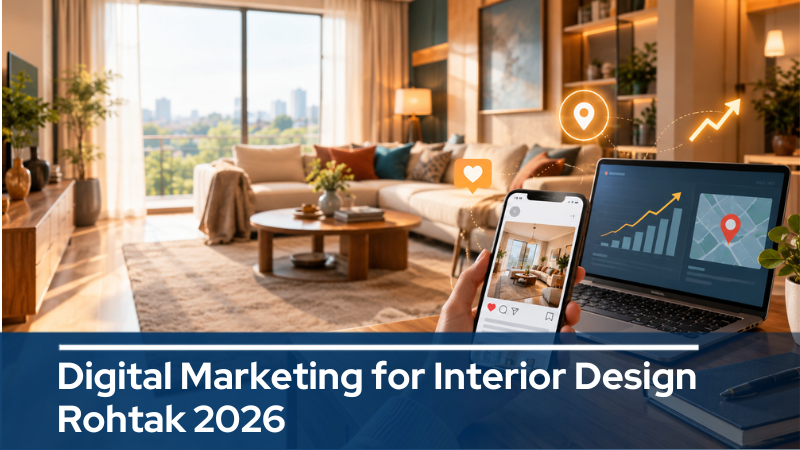
Most interior design clients in Rohtak now shortlist designers on their phones, and what they see there comes down to your SEO and your website. Before anyone calls you, they have already looked at your photos, read your reviews and compared you with two or three other names. If your best work is sitting in a phone gallery instead of on Google, the project goes to someone else.
That is the quiet frustration of many talented designers: the work is excellent, the referrals are steady, but enquiries stay unpredictable. This guide shows how to turn your portfolio into a reliable source of leads, step by step, in the order that makes the most sense for a business owner.
- Interior design is a high-trust, high-ticket decision, so proof (photos, reviews, process) matters more than discounts.
- Build the base first: Google Business Profile and a portfolio website. Then add content, social media and ads.
- Your portfolio should answer the client's questions, not just show finished rooms.
- Measure enquiries and site visits booked, not just likes.
Why Interior Design Marketing Is Different
An interior project is not a quick purchase. A family may spend weeks thinking about it, speak to several designers, and visit a few sites before choosing. The money involved is large and the work happens inside their home or office, so trust decides everything.
The market is also growing. According to IMARC Group, India's interior design market was valued at about USD 36.89 billion in 2025 and is projected to reach USD 74.73 billion by 2034, a CAGR of 8.16%. The same report says residential work accounts for about 60% of the market, and North India holds the largest regional share at 29%. Research firms estimate the size differently (Mordor Intelligence, for example, puts 2026 at USD 35.48 billion), but they agree on the direction: steady growth.
Growth brings competition. Large players are moving beyond metros: Livspace reported 23% revenue growth in FY25 and announced plans to reach over 200 stores across 100+ cities by March 2026. When national brands arrive in smaller cities, local designers need to be just as visible and just as credible online. The good news is that local knowledge, faster site visits and personal attention are real advantages, if customers can see them.
Step 1: Claim and Complete Your Google Business Profile
When someone searches "interior designer near me", Google shows a map with three businesses before most websites. Earning a place there is a core part of local search optimisation, and it costs nothing to start. Focus on these basics:
- Accurate details: Use your real business name, address, phone number and working hours, and keep them identical on your website and social profiles.
- The right category: Choose "interior designer" as your primary category and add related ones, such as modular kitchen or furniture, only if they truly apply.
- Project photos: Upload finished work, site progress and your team. Add new photos every month so the profile looks active.
- Reviews with substance: Ask clients to mention the room or project type, for example "kitchen and wardrobe for our 3 BHK". Reply to every review personally.
- Service areas and services: List what you actually do: residential, office, shop, clinic, renovation.
For a local service, improvements often show within weeks, although broader SEO usually takes three to six months to build real momentum.
Step 2: Turn Your Portfolio into a Website That Sells Trust
A gallery of pretty rooms is not enough. A prospective client is asking practical questions: What have they done in a home like mine? How do they work? How long does it take? What will it cost roughly? Can I trust them with my money? Your website should answer all of these quietly and clearly.
- Project pages, not just photos: For each project, show the type of space, size, style, materials, timeline and the problem you solved. Before-and-after images work especially well.
- A clear process: Consultation, concept, 3D design, quotation, execution, handover. Visitors relax when they can see the road ahead.
- Honest pricing guidance: You do not need to publish a rate card, but explain what affects the cost, such as materials, area and finish level.
- Easy contact: A short enquiry form, a call button and a WhatsApp button on every page.
- Speed on mobile: Heavy image galleries can slow a site down, so images must be compressed properly.
If you are not sure what goes into a good site, this simple explainer on what website design really means is a useful starting point. The deeper question is how a website turns visitors into customers, because beautiful pages that never generate enquiries are expensive wallpaper. When you are ready to build, professional website design should be planned around your leads, and this guide on choosing a website design company lists what to compare before you decide.
Step 3: Show Up for the Searches That Bring Real Clients
Local SEO simply means matching what people type. Interior design searches usually fall into a few groups, and each needs its own page or section:
| Client intent | Example searches | Where to answer it |
| Finding a designer | interior designer near me, home interior designer | Home page, Google Business Profile |
| Specific rooms | modular kitchen design, wardrobe design, false ceiling ideas | Dedicated service pages |
| Space type | office interior design, shop interior, clinic interior | Commercial projects page |
| Planning and cost | 3 BHK interior cost, how to plan home interiors | Blog guides and FAQs |
Helpful articles are what build early trust. A guide such as "How to plan your home interior budget" or "Questions to ask before hiring an interior designer" attracts people who are weeks or months from deciding. By the time they are ready, your name is already familiar. Technical foundations like page speed, clear titles and on-page SEO help Google understand and rank those pages.
Step 4: Let Instagram and Pinterest Do the Showing
Interior design is one of the most visual businesses there is, which makes social media a natural fit. People browse Instagram and Pinterest to collect ideas long before they speak to a designer. Through social media marketing, you can be part of that inspiration phase. Content that works well includes:
- Room walkthrough Reels with natural light, smooth movement and a short caption about the idea behind the design.
- Before-and-after transformations, which prove your skill better than any slogan.
- Material and finish explainers: laminates versus veneers, lighting choices, space-saving storage.
- Site progress stories, which show that you are organised and that work is happening on schedule.
- Pinterest boards sorted by room and style, each linking back to the matching project page on your website.
Post consistently rather than constantly. Three strong posts a week with clear calls to action will outperform daily posting with no direction.
Step 5: Add Ads When the Foundation Is Ready
Ads are the fastest way to reach people who are about to start a project, but they only work when your profile and website are ready to receive them. Google and Meta ads serve different purposes:
- Google search ads appear when someone searches terms like "modular kitchen designer" or "office interior design", which is a sign of real intent.
- Meta ads (Facebook and Instagram) let you show your best project visuals to homeowners in your area, including people who recently visited your website.
- Lead forms and WhatsApp ads make it easy for an interested person to ask for a consultation without filling a long form.
Timing matters. Many families plan renovations before Diwali or around weddings, so campaigns work best when they begin a few weeks earlier. Our note on preparing for the festival season is a helpful planning reference. Start with a modest budget, test two or three creatives, and put more behind whatever produces genuine consultation requests.
Step 6: Convert Enquiries into Signed Projects
Marketing brings the enquiry, but your follow-up wins the project. Many designers lose clients not because of price, but because of slow or unclear communication.
- Reply fast. Respond to calls and WhatsApp messages within the hour during working time.
- Make the next step obvious. Offer a free consultation or site visit with two time options.
- Send a short portfolio matching their type of space, not your entire gallery.
- Follow up on quotations after two or three days with a helpful message rather than pressure.
- Collect proof after handover: a video testimonial, a Google review and permission to photograph the finished space.
Every completed project then feeds the system again, creating new photos, new reviews and new referrals. A small habit helps here: keep a simple sheet listing each enquiry, its source, the date of your first reply and the outcome. Smart Monki clients often find that this one page shows which channel deserves more budget and where leads quietly slip away. It takes five minutes a day and saves months of guessing.
What Does It Cost and How Soon Will You See Results?
There is no universal figure, and anyone who promises a guaranteed number of leads is guessing. A fair expectation: ads can bring enquiries in days, your Google profile can improve within weeks, and SEO becomes a steady source over several months. These channels reinforce one another, so results build up.
You do not have to start everywhere at once. Many designers begin with the profile and portfolio website, then add content and ads once the base is solid. If a new website is on your list, this breakdown of website design costs helps you budget realistically.
Common Mistakes Interior Designers Make Online
- Portfolio without context. Photos alone do not tell clients what you did or why.
- Incomplete Google profile. Missing hours, few photos and no replies to reviews all reduce trust.
- Relying only on referrals. They are valuable, but they are hard to predict or scale.
- Heavy, slow images. Large uncompressed photos make websites crawl on mobile.
- No clear call to action. If a visitor cannot book a consultation in one tap, many will not.
- No tracking. Without knowing where enquiries come from, budgets get wasted.
A Simple 90-Day Plan
Month 1: Foundation. Complete your Google Business Profile, collect your best project photos with short descriptions, and set up or refresh your website with project pages and clear contact options.
Month 2: Visibility. Publish two or three helpful guides, start a regular social calendar, and begin collecting detailed reviews from past clients.
Month 3: Amplify. Launch Google and Meta ads around your next busy period, review which enquiries came from where, and improve what works.
How to Measure What Is Working
Likes do not pay for materials. Track a few practical numbers each month: calls from your Google listing, WhatsApp chats started, consultation requests, site visits booked and projects signed. Ask every new client how they found you and write it down. After two or three months, patterns emerge. At Smart Monki, we keep reporting simple enough for a business owner to read in a few minutes, without a dashboard full of jargon.
How Smart Monki Works with Local Businesses
Smart Monki is a digital marketing and web design team based in Rohtak, with a second office in Bahadurgarh. We work with local businesses, startups and growing brands, and we start by understanding the business before choosing any channel. Website, SEO, ads and social media are planned to work together rather than as separate packages, and our pricing is built for small and mid-sized businesses, so quality marketing stays within reach.
Our work has helped clients such as Neded Institute reach the top of Google for local searches, and you receive clear monthly reports so you always know what was done and what it produced. If you are comparing options, this overview of digital marketing companies in Rohtak shows how local agencies differ.
Final Thoughts
Great interiors already speak for themselves. Digital marketing simply makes sure the right people see them at the moment they are choosing a designer. Complete your Google profile, build a portfolio website that answers real questions, share your process on social media, and use ads to add momentum when the season is right. Do these steps in order and keep at them, and your enquiries will stop depending on luck.
Enjoying our content? Make us a preferred source on Google.
Add us as Preferred Source