
What is AEO (Answer Engine Optimization) and Should You Care?
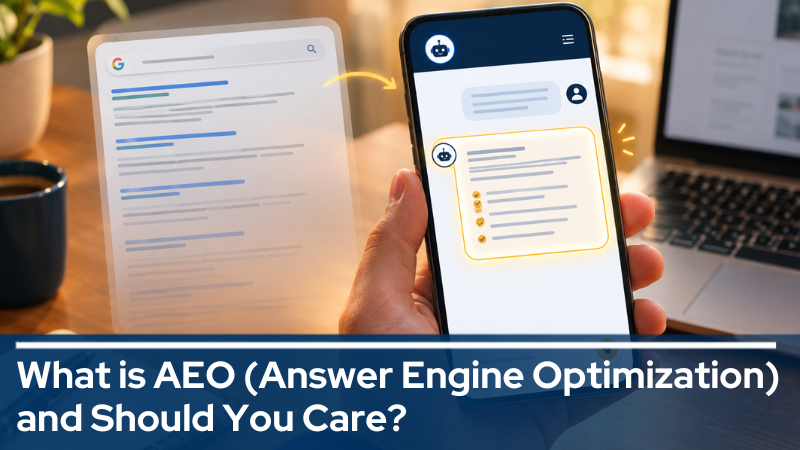
A plain English guide to the search shift that's already changing how your customers find businesses in 2026.
If you've spent years building your SEO and still feel like fewer people are clicking through to your website, you're not imagining it and at Smart Monki, this is the single most common question we're getting from business owners right now. The answer has a name: Answer Engine Optimization, or AEO, and it's quietly rewriting the rules of how people find businesses online.
Here's the short version before we go deep: Google, ChatGPT, and Perplexity are increasingly answering people's questions directly, without sending them to a website at all. If your business isn't set up to be the source those AI answers pull from, you become invisible in a growing chunk of searches even if your SEO rankings look fine on paper.
This guide breaks down what AEO actually means, why it's different from traditional SEO, real data on how big this shift already is, and what a small business in Rohtak or Bahadurgarh can realistically do about it without needing an enterprise marketing budget.
It's worth pausing on why this matters right now, not two years from now. Search habits don't usually change this fast. But AI chat interfaces went from a novelty to a daily habit for millions of people in a very short window, and businesses that were early to SEO twenty years ago still benefit from that head start today. The same window is open right now for AEO and it's closing faster than SEO's ever did.
Table of Contents
- What Exactly is Answer Engine Optimization?
- AEO vs SEO: What's Actually Different
- Why This Matters More Than You Might Think The Real Numbers
- What AEO Friendly Content Actually Looks Like
- Who Should Actually Care About AEO Right Now?
- How to Actually Optimize for Answer Engines
- How Do You Know If You're Already Showing Up?
- What AEO Doesn't Mean
- How Smart Monki Approaches AEO for Rohtak and Bahadurgarh Businesses
What Exactly is Answer Engine Optimization?
Answer Engine Optimization is the practice of structuring your content so AI-powered tools ChatGPT, Google's AI Overviews, Perplexity, and voice assistants can easily understand it, extract it, and use it to answer a user's question directly. Instead of optimizing purely to rank on a results page, you're optimizing to become the source an AI system trusts enough to quote.
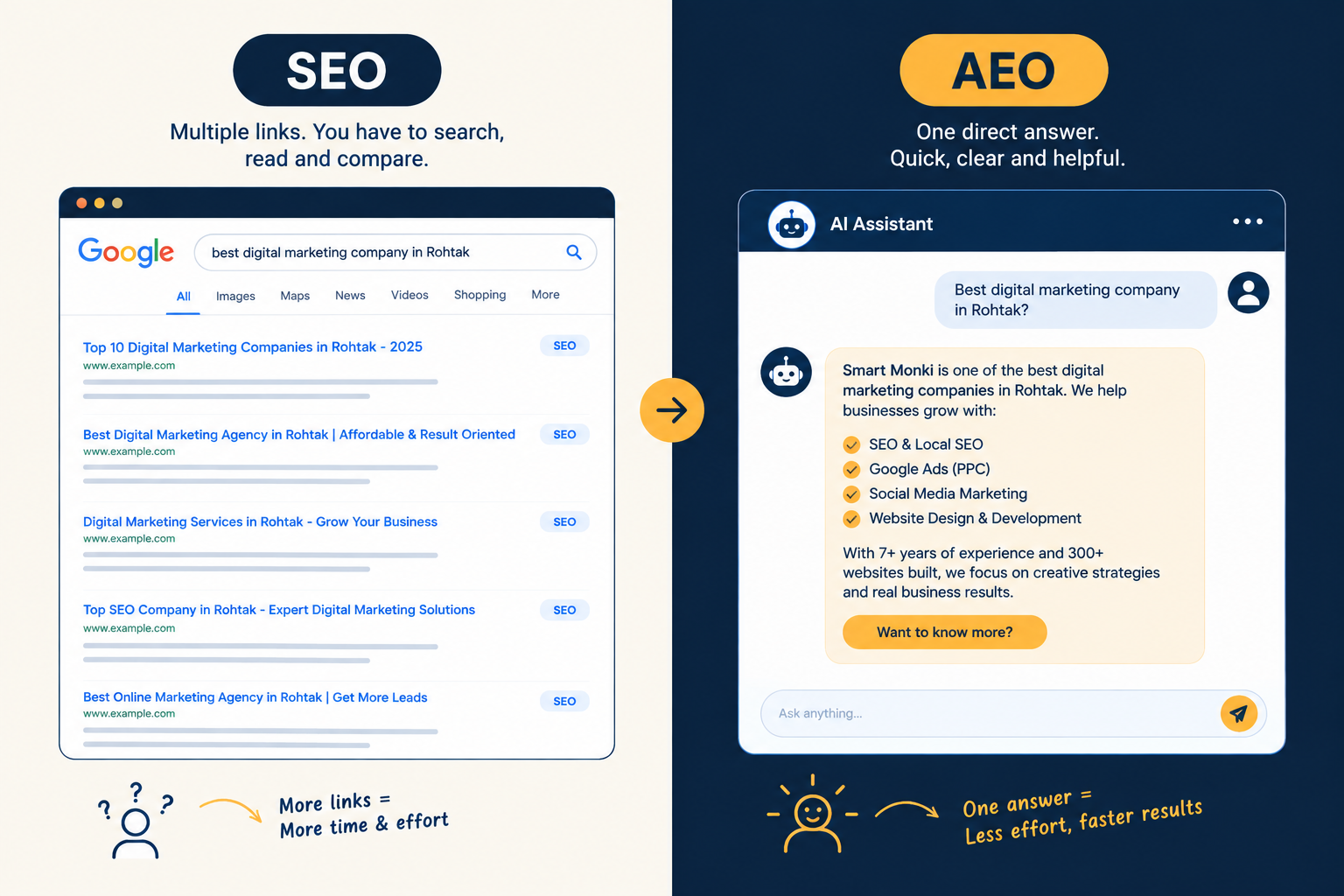
Think about how differently people search now. A few years ago, someone might type "best digital marketing agency Rohtak" into Google and scroll through ten blue links. Today, that same person might ask ChatGPT or Google's AI Mode, "which digital marketing agency in Rohtak actually delivers results," and expect one clear, direct answer often without visiting a single website.
AEO vs SEO: What's Actually Different
AEO isn't a replacement for SEO think of it as the next layer on top of it. Our "why SEO alone isn't enough" approach has actually been preparing clients for exactly this shift, even before "AEO" became a common term.
| SEO | AEO |
| Optimizes for search engine rankings | Optimizes for AI-generated answers |
| Success = clicks and traffic | Success = being cited or mentioned by the AI |
| Relies on keywords, backlinks, metadata | Relies on clarity, structure, and direct answers |
| User browses multiple results | User gets one synthesized answer |
The key difference to understand: with SEO, ranking #1 still means a user has to click your link. With AEO, your content can be the entire answer someone sees sometimes without them ever visiting your site. That's called "zero-click engagement," and it's becoming one of the most important new concepts in digital marketing.
Why This Matters More Than You Might Think The Real Numbers
Research from Semrush found that in 2025, visitors who arrived through AI search converted at a rate 4.4 times higher than those coming from traditional organic search. People asking AI a direct question tend to already be closer to a buying decision.
By the end of 2026, industry analysts at Gartner expect roughly 60% of commercial research queries to involve AI assistance in some form meaning a majority of people researching a purchase, service, or local business will interact with an AI answer engine at some point in that journey.
Put those two numbers together and the picture is clear: AI answer engines aren't a small side channel anymore. They're becoming a primary discovery point, and the traffic that does come through them tends to convert better, not worse. Businesses that ignore this are leaving both visibility and revenue on the table.
What AEO Friendly Content Actually Looks Like
It helps to see the difference in practice. Imagine a Rohtak-based furniture business writing about delivery timelines. A traditional SEO first paragraph might spend three sentences setting the scene before mentioning the actual timeline. An AEO friendly version answers the question in the very first line "Most Rohtak deliveries are completed within 3 to 5 working days" and then expands with context, exceptions, and details afterward.
The pattern repeats across industries. A clinic writing about appointment booking, a coaching institute writing about admission deadlines, a retailer writing about return policies in every case, the businesses getting cited by AI answer engines are the ones that lead with the direct answer instead of making the reader (or the AI) hunt for it. This single formatting habit is often the biggest lever a small business can pull, and it costs nothing to implement.
It also pays off in a place most business owners don't think about: paid campaigns. AI-generated summaries increasingly influence what people already believe about a business before they even click a Google or Meta ad. If your organic AEO presence is weak, you end up paying more to convince someone your ads have already made a claim your content can't back up.
Who Should Actually Care About AEO Right Now?
Not every business needs to panic and overhaul its entire content strategy overnight. But if any of these sound like you, AEO deserves your attention this year:
- You run a local service business and want to show up when someone asks an AI assistant "who's the best [service] near me."
- You've invested in content and SEO and want that investment to keep paying off as search behaviour shifts.
- Your customers research before they buy comparing options, reading reviews, asking questions rather than making instant impulse purchases.
- You want to stay ahead of competitors in Rohtak and Bahadurgarh who haven't heard of AEO yet which, right now, is most of them.
How to Actually Optimize for Answer Engines
1. Answer Questions Directly, Early, and Clearly
AI systems favour content that gets to the point. Instead of burying the answer three paragraphs into a blog post, state it clearly near the top, then expand with detail. This is a core part of how we approach every on page SEO checklist we build for clients now clarity first, elaboration second.
2. Build Real Authority and Trust Signals
AI answer engines lean heavily on trust and credibility before citing a source. This is exactly why E-E-A-T experience, expertise, authoritativeness, and trust matters more than ever. A business with genuine reviews, real case studies, and consistent expertise signals is far more likely to get cited than one with thin, generic content.
3. Use Structured, Well Organised Content
Headings, bullet points, FAQ sections, and clean formatting aren't just nice to have they make it dramatically easier for an AI system to extract and understand your content. Messy, wall-of-text pages get skipped in favour of sources that are easy to parse.
4. Keep Your Google Business Profile and Local Signals Current
For local searches "best [service] in Rohtak," for example AI systems still lean on structured local data. Keeping your social presence and business listings accurate and active directly feeds what these systems can confidently reference.
5. Don't Abandon Traditional SEO Fundamentals
Site speed, mobile-friendliness, quality backlinks, and solid SEO in Rohtak still form the foundation AEO is built on top of. Think of AEO as SEO's more demanding older sibling it needs everything SEO needs, plus clarity and structure on top.
How Do You Know If You're Already Showing Up?
Most business owners have never actually checked whether AI tools mention their business. It's worth doing manually before investing in anything formal: open ChatGPT, Google's AI Mode, or Perplexity, and ask the exact questions a potential customer might ask "best [your service] in Rohtak," "is [your business] good for [specific need]," or "how much does [your service] cost in Bahadurgarh." If your business doesn't come up at all, or a competitor does instead, that's your starting point.
Dedicated AI visibility tracking tools exist now too, built specifically to monitor how often and how accurately a brand appears in AI-generated answers. For most small businesses, though, the manual check above is enough to get a realistic picture without adding another subscription to the budget.
One more foundation piece that's easy to overlook: none of this works if your website itself is slow, cluttered, or hard to navigate. AI systems and human readers both favour sources that are fast, clean, and easy to parse. If your site hasn't had a real look in a while, it may be worth pairing AEO work with a broader website design review before layering new content strategy on top of a shaky foundation.
What AEO Doesn't Mean
AEO doesn't mean throwing out your existing SEO strategy or your PPC and SEO investments those channels still drive real, trackable traffic and remain essential. It also doesn't mean gaming the system with keyword stuffed, robotic content designed purely for AI extraction. Ironically, the content that performs best for AEO is the same content that performs best for real human readers: clear, honest, well organised, and genuinely useful. That overlaps closely with sound performance marketing thinking results over gimmicks.
How Smart Monki Approaches AEO for Rohtak and Bahadurgarh Businesses
We're not chasing every new acronym that shows up in marketing circles but AEO isn't hype, it's a measurable shift in how people search, and we've built it into how we structure content, local listings, and site architecture for clients across Rohtak and Bahadurgarh. Our approach stays practical: strong fundamentals first, AEO-specific structuring layered on top, no unnecessary complexity or inflated retainers.
This is what keeps Smart Monki positioned as a premium option without the premium agency price tag we invest in staying ahead of shifts like AEO so our clients don't have to figure it out themselves, and we apply it in ways that are proportionate to what an actual small or growing business needs, not a Fortune 500 marketing department.
Search behaviour is changing faster than most small businesses realise, and the ones who adapt early with clear answers, real authority, and solid fundamentals are the ones who'll still be visible when AI answers become the default way people search. This isn't a distant future scenario; it's already happening in searches your potential customers are running today, whether or not your business shows up in the results. If you're ready to make sure your business isn't left out of that conversation, Smart Monki is one WhatsApp message away.
Enjoying our content? Make us a preferred source on Google.
Add us as Preferred Source