
Google Ads for Interior Design Rohtak 2026
Somebody in Rohtak is typing “interior designer near me” into Google right now, and the first designer they see usually gets the call. With Google Ads, that can be you, without waiting months for SEO to catch up.
There is a catch, though. A badly set-up campaign burns money faster than a badly priced quote. Many designers who “tried Google Ads once” quit within weeks because they paid for clicks that never became consultations. That is rarely Google’s fault. It is almost always a setup problem, and it is fixable.
This guide explains how an interior design business should plan, fund, run and measure Google Ads in 2026, in the order you will actually need it. No jargon, and no promises of guaranteed leads.
- Google Ads works for interior design because it reaches people who are already searching for a designer.
- A realistic starting budget for a local campaign is ₹10,000 - ₹15,000 a month.
- Leads come from structure: matching keywords, location, ad copy and landing page.
- Judge success by consultations and signed projects, not by clicks.
Table of Contents
- Why Google Ads Suits Interior Design Businesses
- How Much Does Google Ads Cost for an Interior Designer?
- The Campaign Structure That Brings Consultations
- Write Ads and Landing Pages That Make People Call
- Do Not Lose the People Who Almost Called
- Time Your Campaign Around the Busy Season
- Measure Consultations and Signed Projects, Not Clicks
- What Your First 30 Days Should Look Like
- Six Google Ads Mistakes Interior Designers Make
- How Smart Monki Approaches Google Ads for Interior Designers
- Final Thoughts
Why Google Ads Suits Interior Design Businesses
Most advertising interrupts people. Google Ads does not. Someone searching for a “modular kitchen designer” has already decided they want one, and you are simply competing to be the name they call. Three things make interior design a natural fit:
- High intent. Search ads reach people at the exact moment they are looking for a designer.
- High project value. A single signed project can be worth lakhs, so paying for a genuine enquiry is easier to justify than in a thin-margin business.
- Local control. You serve one city, so ads can be shown only to people you can actually reach.
The market is moving too. According to IMARC Group, India’s interior design market was valued at about USD 36.89 billion in 2025 and is projected to reach USD 74.73 billion by 2034, growing at roughly 8.16% a year. More demand means more designers competing for the same searches. For the full picture beyond ads, our complete interior design marketing guide covers the Google Business Profile, website and social media.
One more data point: WordStream’s 2026 benchmarks, which are US data, put the average search conversion rate for home and home improvement businesses at around 8%. Indian numbers will differ, but it shows how well intent-driven search converts when the landing page does its job.
How Much Does Google Ads Cost for an Interior Designer?
At Smart Monki, we usually recommend a starting budget of ₹10,000 - ₹15,000 a month for a local campaign. A much lower budget brings too few clicks and enquiries to show which keywords and ads actually work.
Cost per click is harder to pin down. Published Indian benchmarks disagree widely: one 2026 benchmark puts home services at around ₹12 per click, while other agency guides quote ₹20 to ₹150 for search ads in general. Treat any single number with caution and check Google’s Keyword Planner for your exact searches.
Here is a simple, illustrative example. Suppose ₹12,000 buys about 600 clicks at ₹20 each. If 3 in every 100 visitors send an enquiry, that is roughly 18 enquiries. If two or three become signed projects, the maths looks very different from the ₹12,000 spent. If none do, the fix is usually the landing page or the follow-up, not a bigger budget. These figures are planning assumptions, not a promise. For a wider view of agency pricing, see our breakdown of digital marketing costs for small businesses.
Timing is reasonable too. Campaigns can go live within 24 to 48 hours, and performance usually improves over the first two to four weeks as Google gathers data and targeting is refined.
The Campaign Structure That Brings Consultations
Google Ads rewards structure. Instead of one campaign for everything, group your keywords by what the searcher wants, and give each group its own ads:
| Group | Example searches | Intent level |
| Hire-ready | interior designer near me, home interior designer | Very high |
| Room-specific | modular kitchen designer, wardrobe design, false ceiling | High |
| Commercial | office interior design, shop interior, clinic interior | High, larger projects |
| Research | 3 BHK interior cost, interior design ideas | Lower, start small |
Then tighten the controls that stop money leaking out:
- Location: Target Rohtak and only the areas you genuinely serve, using pin codes or a radius. Neighbourhoods such as Model Town and Civil Lines can be targeted precisely.
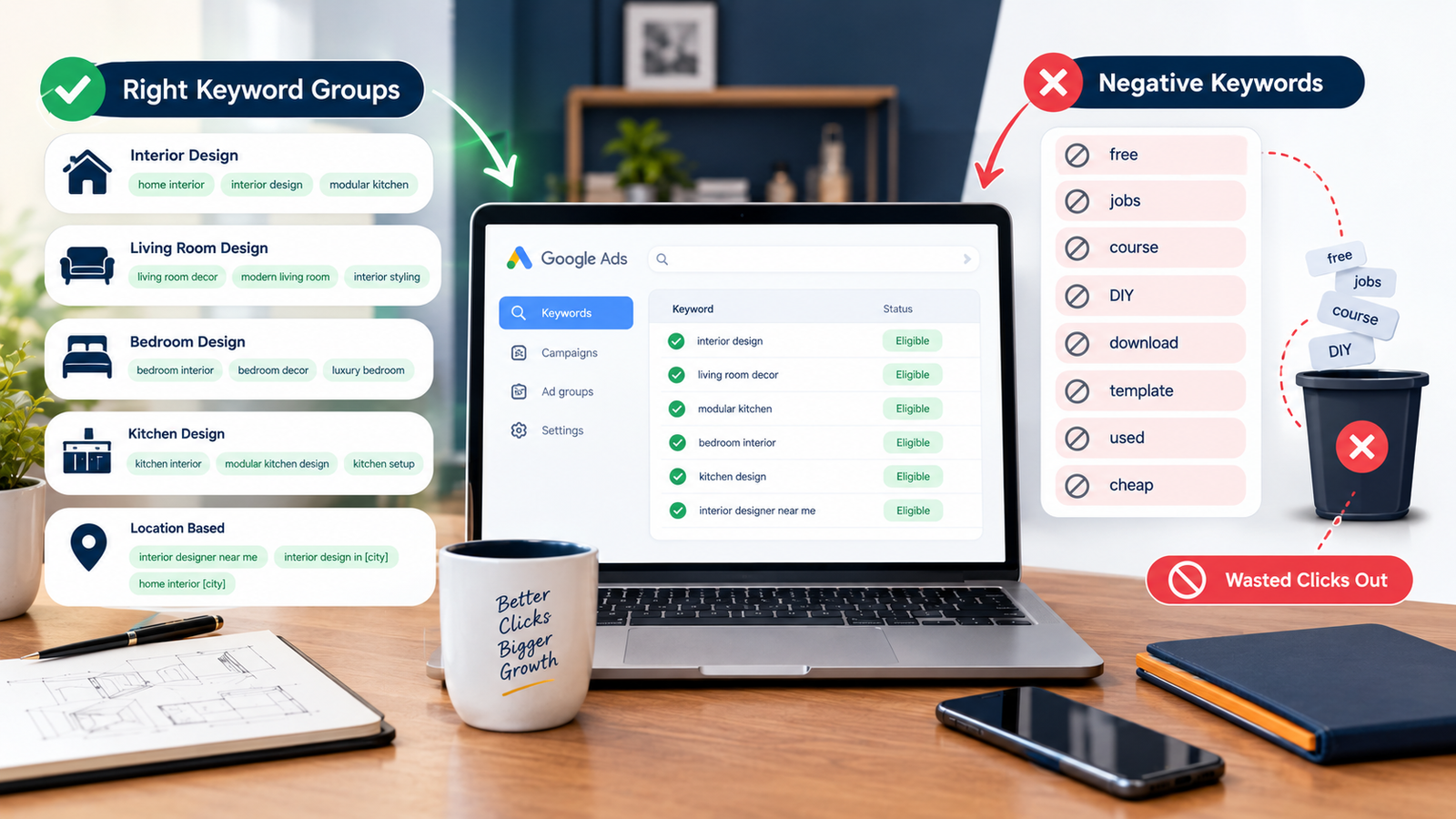
- Negative keywords: Block words like “free”, “jobs”, “course”, “software” and “images” so you stop paying for people who were never going to hire you.
- Match types: Start with phrase and exact match for your core terms. Broad match without limits is the most common way budgets disappear.
- Ad schedule: Show call buttons when someone can answer, and use WhatsApp based ads for after-hours enquiries.
- Extensions: Add call, location and sitelinks such as “Our Projects” and “Get a Quote”.
Relevance also affects what you pay. Google scores how well your ad, keyword and landing page match each other, known as Quality Score, and better alignment can lower your cost per click. This is another reason one page per service beats a single catch-all homepage.
If you are deciding between paid and organic work, this explanation of how SEO and Google Ads compare will help you choose the right order for your budget.
Write Ads and Landing Pages That Make People Call
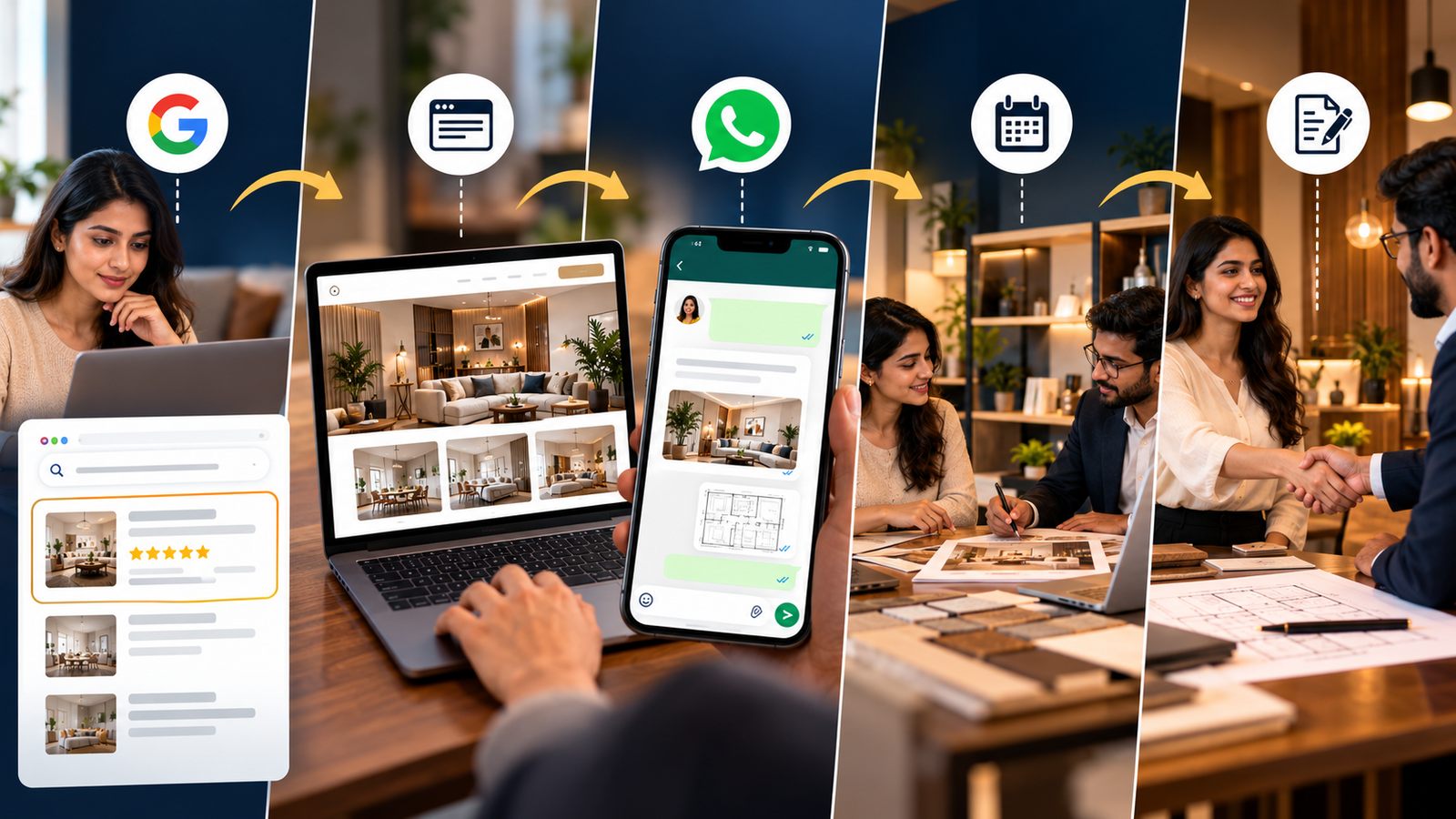
A good ad is specific. Include the service, the city and one reason to choose you, for example “Home Interior Designer Near You | Free Site Visit | 3D Design and Execution”. Only promise what you genuinely offer. If your site visit is not free, do not say it is.
The click is only half the job. Where it lands decides whether you get a call. A strong landing page for interior design usually has:
- One page per service, so a kitchen search lands on kitchen work, not on a general homepage.
- Real project photos with the space type, size and a rough budget bracket.
- A clear process: consultation, 3D design, quotation, execution, handover.
- Visible contact options: a call button, a WhatsApp button and a short form on every screen.
Speed matters because most searches happen on phones. Google research widely cited by developers found that 53% of mobile visits are abandoned when a page takes longer than three seconds to load, and heavy photo galleries are the usual culprit. A fast, mobile-first website keeps those visitors on the page, and a simple business site can be ready in five to seven days. To see what separates a landing page that converts from one that does not, read our guide to building a high-converting landing page.
Do Not Lose the People Who Almost Called
Interior design is rarely an instant decision. A family may compare several designers over weeks, so most visitors will leave your page without enquiring. That is normal, and it is where remarketing helps. It shows follow-up ads to people who already viewed your work, so you stay visible while they decide.
Meta ads suit this stage well, because project visuals perform best on Instagram and Facebook. Consistent social media marketing gives those retargeting ads fresh material and keeps your brand familiar between searches. Our note on how to generate leads from Google shows how search, profile and website work together to support the same goal.
Time Your Campaign Around the Busy Season
Interior enquiries are not spread evenly through the year. Many families plan renovations before Diwali, and the wedding season brings homeowners who want a finished home before the function. Starting a campaign a few weeks before these periods gives Google time to learn, so you are already optimised when search demand rises.
Quieter months are useful too. They are a cheaper time to test new ad copy, try a different landing page or build your remarketing audience. Whatever you learn then makes the busy months more efficient.
Measure Consultations and Signed Projects, Not Clicks
Clicks and impressions feel productive, but they do not pay for materials. Set up tracking before launch, and watch the numbers that matter:
- Phone calls from ads, using call tracking
- WhatsApp chats started
- Form enquiries and consultation requests
- Site visits booked
- Projects signed, and which campaign they came from
Then compare cost per enquiry with cost per signed project. Because interior projects are large, the second number tells you whether the campaign is truly paying off. Ask every new client how they found you and write it down. Give a campaign at least four weeks before judging it, and expect clear reporting during that time. Our guide on what happens after you hire a digital marketing agency explains what a good reporting rhythm looks like.
What Your First 30 Days Should Look Like
A good launch is calm and methodical, not chaotic. This is a sensible shape for the first month:
- Week 1: Finalise keywords, location targeting, ad copy and the landing page. Set up call, WhatsApp and form tracking, and test every one of them before spending a rupee.
- Week 2: Go live and let the data arrive. Review search terms daily at first, and add negative keywords as irrelevant searches appear.
- Week 3: Pause weak keywords, test a second version of your best ad, and check which parts of the landing page people actually use.
- Week 4: Compare enquiries with real conversations. Which leads were serious, which were not, and what does that say about your keywords?
By the end of the month, you should know which searches bring serious enquiries and what each one costs. That clarity is the real return on the first month, and it makes every later rupee work harder.
Six Google Ads Mistakes Interior Designers Make
- Broad match with no negative keywords. You pay for irrelevant searches such as free designs and job vacancies.
- Sending every click to the homepage. Visitors cannot find the service they searched for, so they leave.
- Spreading a small budget across many campaigns. One focused campaign teaches Google more than five thin ones.
- No conversion tracking. Without it, you cannot tell which keywords bring consultations.
- Quitting in week two, or changing everything daily. Campaigns need time and steady, deliberate adjustments.
- Slow follow-up. An enquiry answered after a day is often already lost. Reply within the hour during working time.
How Smart Monki Approaches Google Ads for Interior Designers
Smart Monki is a digital marketing and web design team based in Rohtak, with a second office in Bahadurgarh. We start with your business, not the platform: what you design, your usual project size, the areas you serve and what a good enquiry looks like. The campaign, landing page and tracking are then built together, so they work as one system.
Our ads are managed by Google and Meta certified specialists, and you receive a monthly report that shows spend, enquiries and what we changed in plain language. Our pricing is built for small and mid-sized businesses, so careful, quality management stays within reach. If you also want search, website and social media working together, our digital marketing services are planned as one connected strategy.
Final Thoughts
Google Ads will not make your design work better, but it can put it in front of people at the moment they are ready to choose. Build structured campaigns, send clicks to pages that answer real questions, track consultations rather than clicks, and give the process time. Done in that order, ads stop feeling like a gamble. For local support across the region, explore our local digital marketing services
Enjoying our content? Make us a preferred source on Google.
Add us as Preferred Source