
Social Media Marketing for Interior Design Rohtak 2026
You post a stunning modular kitchen, collect 80 likes from friends and relatives, and receive zero real enquiries. The gap between a pretty feed and a booked project is exactly what social media marketing closes, and a trustworthy website is what finishes the job.
This guide is written for interior design business owners. No jargon, no vanity metrics. We will cover where your clients actually spend time, what to post, what to skip, how to measure real enquiries, and what a sensible 30-day plan looks like. Read it once and you can start on Monday.
Table of Contents
- Why Social Media Now Decides Who Gets the Call
- Where Your Clients Actually Spend Their Time
- Six Content Types That Actually Bring Enquiries
- Finished project reveals with context
- Before and after, with the problem named
- Process and site-visit content
- Client walkthroughs and reviews
- Education that answers real questions
- Honest pricing and material talk
- Set Up Your Instagram So Enquiries Are Effortless
- Reel Ideas That Work for Design Businesses
- Make Local Discovery Work for You
- Mistakes That Quietly Cost Interior Designers Leads
- When to Add Paid Ads (and When Not To)
- A 30-Day Plan You Can Actually Follow
- Measure Enquiries, Not Applause
- How Smart Monki Helps Interior Designers Grow
Why Social Media Now Decides Who Gets the Call
Think about how a family plans a home renovation today. They do not open a directory. They save reels, screenshot layouts and forward them to the family WhatsApp group long before they call anyone. By the time a designer hears from them, half the shortlisting is already done.
The data backs this up. Deloitte India's 2026 report, The Home Reset, found that nearly 80 percent of home shoppers discover products through social media, and that 57 percent of consumers aged 18 to 28 look to creators and influencers for inspiration, compared with 27 percent of those aged 45 to 60. The same report notes that consumers now spend 10 to 15 percent of a home's value on interiors. That is a serious budget, and a lot of it is decided on a phone screen.
Platform numbers point the same way. NapoleonCat's June 2026 figures count about 553 million Instagram users in India and roughly 707 million on Facebook. The largest Instagram age group is 25 to 34, around 213 million people, which is the bracket where many people buy or renovate their first home.
For a designer in Rohtak, this cuts both ways. You compete with every polished big-city studio your client scrolls past. But you also have something they do not: you can visit the site this week, understand a Model Town floor plan or a Sainik Colony renovation, and speak the client's language. Social media is how you make that advantage visible. If you want the wider picture beyond social, our complete digital marketing guide for interior designers covers every channel.
Where Your Clients Actually Spend Their Time
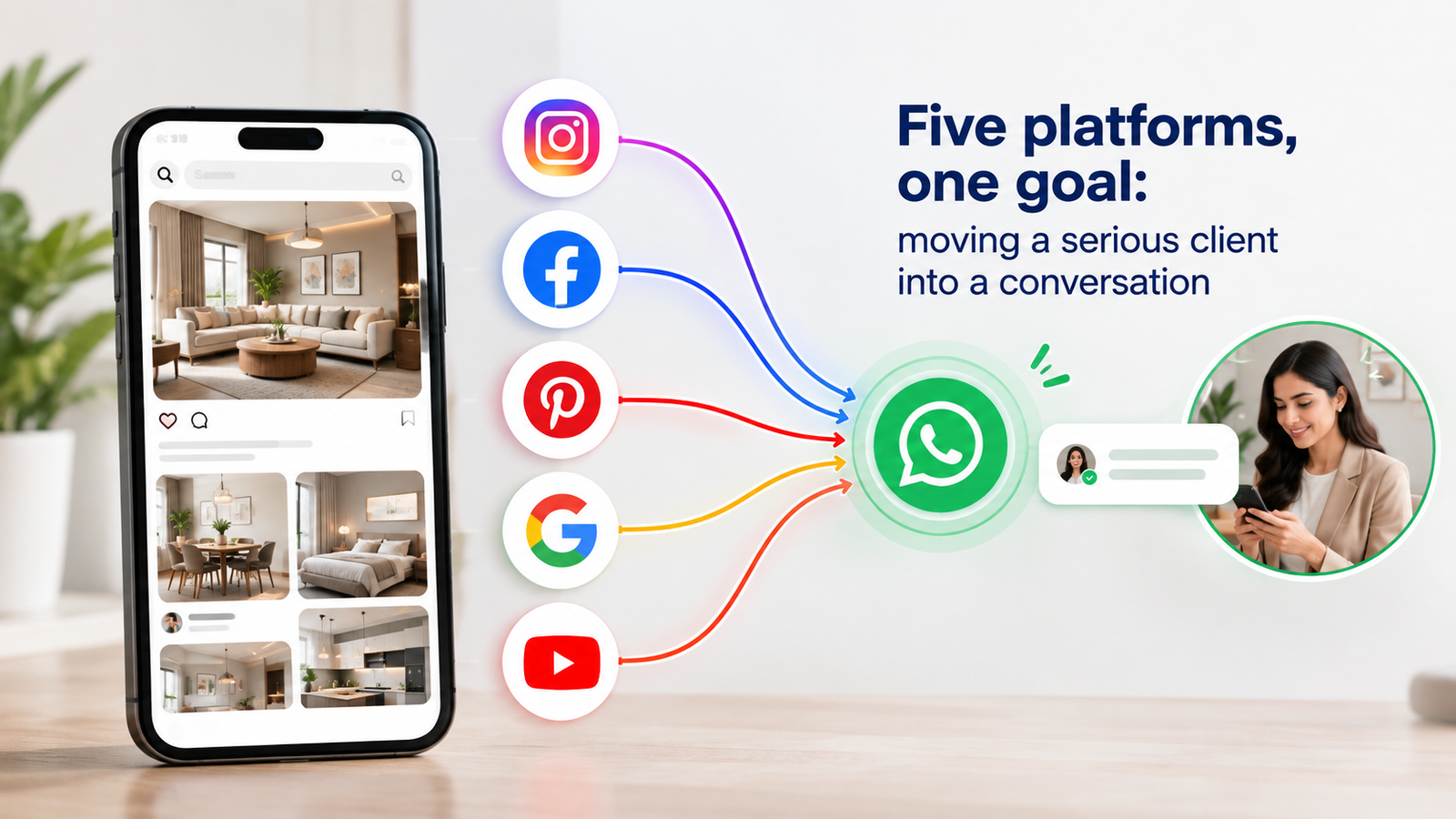
You do not need to be everywhere. You need to be in the right five places and know what each one is for.
- Instagram is your portfolio. Reels bring new people in, carousels and Stories convince them, and Saves tell you who is seriously planning a project.
- Facebook is your trust layer. With nearly half of India's population on it, it is where parents and older family members, often the ones approving the budget, still spend time. Local groups and page reviews matter here.
- YouTube is your depth. A ten-minute site walkthrough answers questions that a 15-second reel cannot, and Shorts let you reuse the same footage.
- Pinterest is your slow-burn inspiration board. Pins of your finished rooms keep circulating for months and can send visitors to your website.
- WhatsApp is where the deal closes. Every other platform exists to move people into a WhatsApp conversation with you.
Six Content Types That Actually Bring Enquiries
Random posting is the main reason feeds stall. Give every post one job, and rotate between these six.
1. Finished project reveals with context
A photo alone is decoration. Add the carpet area, the city or neighbourhood, the style brief and the timeline. A homeowner comparing designers wants to picture their own flat in your work.
2. Before and after, with the problem named
"Dark, cramped 2 BHK with no storage" followed by the transformation tells a story. Naming the problem lets viewers see themselves in it.
3. Process and site-visit content
Material selection, measurement day, carpentry progress, quality checks. Delays and unreliable workmanship are the fears that hold back most clients, and showing your process answers them before they ask.
4. Client walkthroughs and reviews
A 30-second video of a happy family in their finished home does more than any caption you write. Always take permission first and keep it natural, not scripted.
5. Education that answers real questions
Sliding versus hinged wardrobes, plywood grades, how long a full-home project takes, what a modular kitchen costs in broad ranges. These are the questions people type or voice-search before contacting anyone, and they position you as the expert.
6. Honest pricing and material talk
You do not have to publish a rate card, but explaining what drives cost builds trust quickly. Clients who understand your pricing logic argue less about it later.
Set Up Your Instagram So Enquiries Are Effortless
Most interior designers lose leads at the profile, not the post. Someone loves a reel, taps your name, and finds a vague bio and no clear next step. Fix the basics first:
- Bio: what you do, where you work, one proof point, one action. For example: "Home interiors | Rohtak and nearby | [your number] homes delivered | Book a free consultation."
- Link: point it to WhatsApp or a proper enquiry page, not a dead link.
- Highlights: Projects, Process, Reviews, Pricing FAQs, Contact. These are your always-on sales team.
- Pinned posts: your three strongest projects at the top, not whatever you posted last.
- Reply speed: answer DMs within an hour during working hours. A fast, polite reply often wins the project over a better-looking competitor.
Reel Ideas That Work for Design Businesses
Running out of ideas is the second biggest reason feeds go quiet. Keep this list on your phone and shoot two or three of these every time you visit a site:
- "Empty room to finished home" time-lapse: 15 to 20 seconds, same angle at the start and the end, with one line naming the brief.
- "Three things we changed in this 2 BHK": quick cuts of the layout, storage and lighting decisions, each with a short reason.
- Material close-ups: laminate texture, hardware, countertop edges, fabric swatches. People love seeing quality up close, and it quietly justifies your price.
- "Client asked, we answered": turn a real WhatsApp question into a 30-second reply on camera. This is the easiest educational content you will ever make.
- A day on site: measurements, carpenters at work, a delivery arriving. It proves you are present and organised.
Keep the first two seconds visual and specific. A finished kitchen with a text line like "Compact kitchen, 8 by 10 feet, full storage" will always outperform a slow intro with music and no context. Add subtitles too, because most people watch with the sound off.
Make Local Discovery Work for You
Interior design is a local decision. Clients want a designer who can reach the site, so your content should say where you work without sounding like an advertisement. Tag the neighbourhood or city in your captions, add the location to every post, and mention your service area in your bio and Highlights.
Facebook needs the same attention. Keep your page details complete, post your best projects there too, and encourage happy clients to leave a review. Reviews and local tags are what make a nervous first-time client feel safe enough to send that first message.
Finally, set up WhatsApp Business properly. Add your catalogue of services, a greeting message, a short away message and quick replies for common questions like "What is your process?" and "Can I see more projects?" A smooth first reply is part of your marketing, not an afterthought.
Mistakes That Quietly Cost Interior Designers Leads
- Posting only dim, wide-angle phone photos. Good natural light and a few straight-angle shots lift perceived quality instantly. You do not need an expensive camera.
- Trending audio with no project information. A reel can go viral with people who will never hire you. Show the space, the size and the idea.
- Ignoring local signals. Add your location tag and mention your service area so nearby homeowners know you are reachable.
- Treating social media as your only home. Platforms change reach overnight, and serious clients like to verify you elsewhere. We explain this in detail in why social media alone is not enough.
- No website or Google presence. A fast, mobile-friendly site from a local web design team and a complete Google Business Profile, covered in our website and GMB guide for interior designers, catch the people who search instead of scroll.
When to Add Paid Ads (and When Not To)
Ads multiply what already works; they cannot fix weak content. Run organic content for four to six weeks first, note which reels and carousels earn saves and DMs, and only then put budget behind those winners.
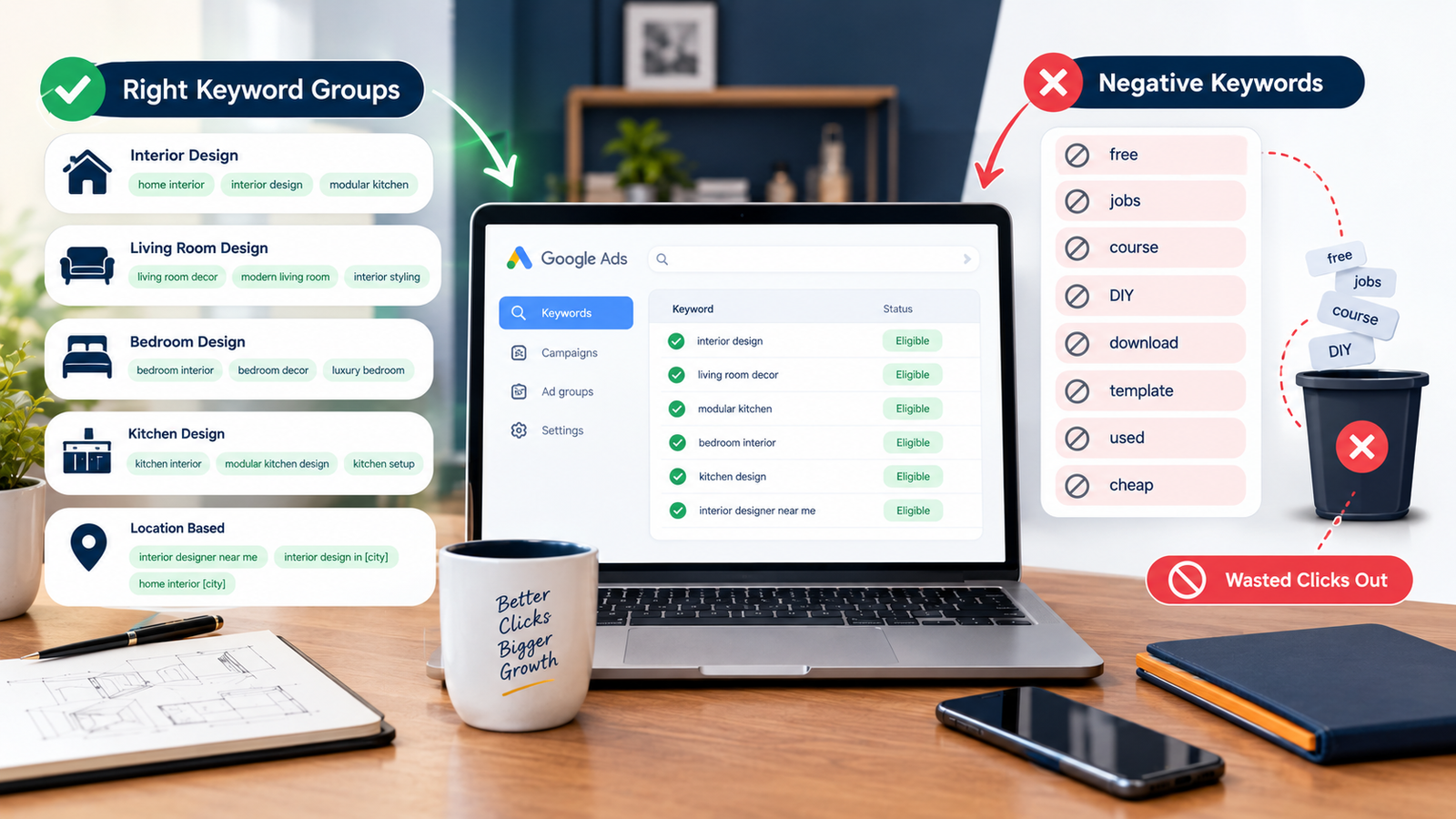
A sensible starting point is a small daily budget on Meta (Instagram and Facebook) targeting homeowners in your service area, using the best-performing project reel with a clear WhatsApp or enquiry-form button. Retarget people who watched most of a video; they are warmer than strangers. Our Google and Meta ads service handles exactly this setup, and if you want to capture people actively searching on Google, our Google Ads guide for interior designers shows how.
Avoid the "boost" button on random posts. It buys reach from people who will never hire you.
A 30-Day Plan You Can Actually Follow
- Week 1, Foundation: rewrite your bio, set up highlights, pin your best three projects, clean up your Facebook page, and gather your best 15 to 20 project photos and videos in one folder.
- Week 2, Batch your content: plan 12 pieces: five reels, four carousels, three educational posts. Write captions and shoot extra footage on your next site visit.
- Week 3, Add proof: publish two client walkthroughs or review posts, a process reel, and daily Stories showing real work. Start replying to every comment and DM within the hour.
- Week 4, Convert: post a clear offer, such as a free first consultation or a site-visit slot, add it to your Stories and bio, and review which posts brought enquiries.
After the first month, do not change everything. Look at your top three posts, work out why they performed, and make more of that. If educational reels earn the most saves, double down on them. If site-walkthrough videos start the most conversations, film one every week. Social media rewards patience and repetition, and the designers who win are rarely the most creative. They are simply the ones who kept showing up for six months while others quit after three weeks.
Measure Enquiries, Not Applause
Likes feel good, but they do not pay for materials. Track these instead, in a simple sheet reviewed once a month:
- Enquiries by source: DMs, WhatsApp chats, calls and form fills. Ask every new client, "How did you find us?" and write the answer down.
- Profile visits and link clicks: they show whether your content makes people curious enough to look further.
- Saves and shares: these signal real intent to plan a project.
- Site visits booked: the number that matters most for a design business.
Social media works best alongside search, because the two reach people at different moments. One catches attention, the other catches intent. Our breakdown of SMM vs SEO helps you decide where to invest first, and our SEO service builds the second half over time.
How Smart Monki Helps Interior Designers Grow
Smart Monki is a digital marketing and web design agency based in Rohtak, with an office at 3rd Floor, Shantmai Chowk, Company Bagh, and a presence in Bahadurgarh. We work with small and tier 2 and 3 businesses across Haryana, and more than 25 businesses are already online with our help. One example is Neded Institute, which ranks number one on Google in Rohtak for its target searches.
Our approach is simple: understand your business first, then build the plan. For an interior design business, that usually means a content system you can sustain, a profile that converts, and a website or Google presence that backs it up. Everything sits under our wider digital marketing service, so your social, search and website work together instead of competing.
We aim for premium-quality work at pricing a growing local business can actually sustain. If budget is your first question, our honest digital marketing cost guide lays out what to expect.
Your best work is already done. The next step is making sure the right people in Rohtak see it, trust it and call you. Start small, stay consistent, and measure what matters.
Enjoying our content? Make us a preferred source on Google.
Add us as Preferred Source